
|
| Stop Sensitive Data Leaks with Cloudmersive Multi Threat Detection |
| 5/21/2026 - Brian O'Neill |
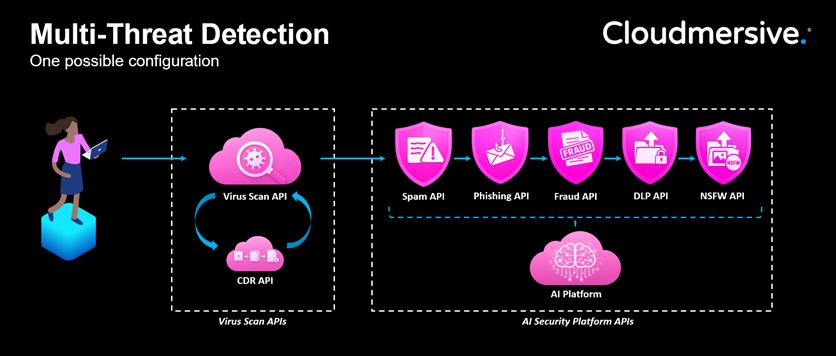
The threat that’s already inside your organizationMalware, zero-day threats, fraud, phishing, and spam typically originate from outside of an enterprise network, not from within it. Data loss is just the opposite: it’s what happens when sensitive information that already exists inside your organization finds its way out. Imagine a compliance officer forwards a spreadsheet containing patient health records to an external consultant, or a developer pastes database credentials into a support ticket. Neither of these examples constitute attacks; they’re just routine operational mistakes. Under GDPR, HIPAA, and PCI-DSS, however, these mistakes carry the same regulatory consequences as deliberate breaches. Why stopping data loss is harder than it looksThe majority of security investment is focused on inbound security. Outbound data governance tends to get less attention, and when it does, it’s usually addressed through policy alone rather than actual enforcement (i.e., guidelines about what employees should and shouldn’t share without a technical layer to verify those guidelines are being followed). Manual oversight is impractical in data loss prevention because the volume and variety of channels through which sensitive data can leave. Emails, file transfers, API traffic, documents, and recorded calls represent a surface area too broad for any compliance team to monitor without automation. And on top of that, the regulatory frameworks don’t usually distinguish between intentional data exfiltration and accidental exposure: if regulated data leaves the organization without authorization, the liability is the same. How the Cloudmersive DLP API addresses enterprise data lossThe Cloudmersive DLP API detects and redacts sensitive data across the full range of content types an enterprise actually works with. For text and documents, the API scans for 35 configurable data types spanning financial identifiers, personal information, health data, and technical credentials. That means data including Social Security Numbers, credit card numbers, IBAN codes, passport numbers, driver’s licenses, bank account numbers, bearer tokens, private keys, source code, and a comprehensive set of HIPAA-relevant PHI fields is covered in a single DLP policy. For audio, the API goes much further than any standard DLP tool. It transcribes audio files in a variety of formats (including WAV, MP3, FLAC, OGG, and WMA), runs the same comprehensive PII detection across the resulting transcript, and returns a redacted version of both the transcript and the audio itself with precise timestamps identifying exactly where sensitive content appeared. For organizations handling recorded customer calls, HR interviews, internal meetings, or any other audio use case, this prevents the type of data loss that text-only DLP leaves wide open. The API has detection and redaction capabilities; organizations can choose to implement detection alone or couple detection with redaction. The redaction piece means replacing sensitive values with asterisks (in text), blacking them out entirely (in documents), and replacing audio with filler sound or silence before content moves downstream. Where the DLP API fits in your workflowsDLP belongs wherever regulated or sensitive data moves across an organizational boundary. Outbound email scanning is a common starting point; it’s the channel employees use the most. Document processing pipelines are another natural fit, particularly for organizations in healthcare, financial services, or legal industries where regulated data is embedded directly in the documents that flow through daily operations. API traffic filtering and recorded audio pipelines round out the coverage for organizations with broader data governance requirements. For organizations using Storage Protect, Cloudmersive’s in-cloud-storage threat scanning solution, DLP can be performed on documents directly after they enter a cloud storage bucket. That way, every file is automatically checked before it’s shared. Deployment optionsLike all Cloudmersive APIs, the DLP API is available across the full range of deployment options listed below. Managed InstanceThese deployments leverage dedicated, managed infrastructure with SLAs, customizable deployment, and security. Private CloudThese deployments can take place on the customer’s premises or in a cloud platform of their choice. Public CloudThese deployments leverage Cloudmersive’s multi-tenant public cloud offering. PaaSThese deployments take advantage of Azure App Service or Azure Kubernetes Service offerings. Government CloudThese deployments take place in a specified government cloud region, suiting the data governance requirements of government entities. Get started with Cloudmersive DLPCloudmersive DLP is an integral part of Cloudmersive Multi-Threat Detection. To learn more about the DLP API, visit our documentation or API console for technical details and code examples. For expert advice, or to book a Multi-Threat Detection demo with your data, reach out to a member of our team. |
Sign Up Now or 

 Blog
Blog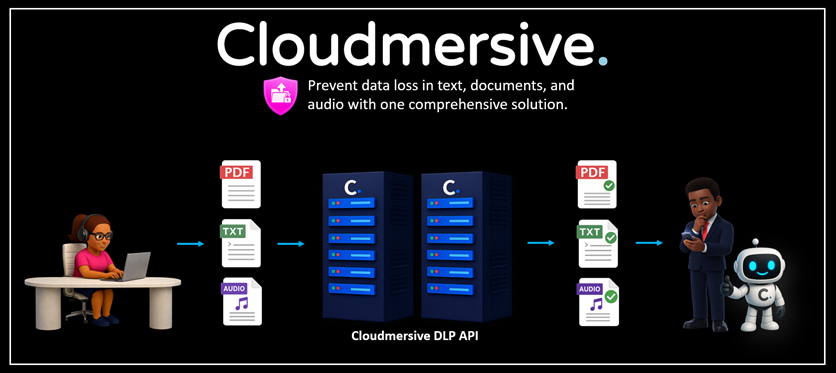
 Virus Scan APIs
 Content Disarm and Reconstruction APIs
 Spam Detection APIs
 Document Conversion & Processing APIs
 Document AI APIs
 Natural Language Processing (NLP) APIs
 Optical Character Recognition (OCR) APIs
 Image and Face Recognition and Processing APIs