
|
| Cloudmersive Multi-Threat Detection as a Unified Approach to Enterprise Security |
| 4/17/2026 - Brian O'Neill |
There’s no single “threat” targeting enterprise networks. Today’s attacks come from all different angles all the time. Combating multiple threats requires a unified security posture: Cloudmersive’s full suite of threat detection capabilities deployed together as a comprehensive enterprise security layer. Why single-vector security leaves enterprises exposedModern threat actors don’t attack from a single direction. Instead, they probe multiple surfaces simultaneously. If even one attack penetrates a network, it can put the attacker in a position to cripple enterprise infrastructure. A file upload might carry malware, and it might also carry a phishing link. That same file might even contain a different type of threat entirely: exposed personally identifiable information (PII) or NSFW/CSAM content designed to incur compliance violations and undermine enterprise trust. It could be AI-generated, fabricated to look exactly like a real example document but with crucial, nefarious differences in its instructions or calls-to-action for the reader. In years past, enterprises have often approached security gaps one at a time, patching together tools and policies in an unstructured way. Overtime, the result has proved to be a fragmented security barrier with no unified visibility for enterprise security teams. Given how quickly missed threats compound into full-blown security breaches, it’s clear that organizations actually need a solution that matches the multi-dimensional nature of the threat landscape. The four pillars of Cloudmersive Multi-Threat DetectionCloudmersive Multi-Threat Protection combines Cloudmersive’s diverse security API platform into a single, unified security model for enterprises. Virus ScanningThe Cloudmersive Virus Scan API detects malware, ransomware, and zero-day threats in file uploads and document pipelines with exceptional accuracy. The Virus Scan API consistently boasts a Zero Day Detection Rate (ZDDR) of 98% against threat samples not yet stored in antivirus signature databases - a figure which dwarfs market competitors. NSFW DetectionThe Cloudmersive NSFW API detects inappropriate and/or harmful images and videos entering or leaving enterprise systems. NSFW content can lead to emotional damage and reputational loss, not to mention costly legal repercussions. Fraud, Spam & Phishing DetectionThese AI security APIs use advanced AI to detect social engineering attacks, spoofed communications, and other unsafe content targeting employees and customers through text, forms, emails, documents, and other vectors. Cloudmersive AI security APIs often outperform human detection capabilities with live samples. Data Loss Prevention (DLP)The Cloudmersive DLPAPI detects and redacts sensitive PII and regulated data leaks in outbound emails, file transfers, sound clips, and API traffic. Redaction ensures information such as Social Security Numbers (SSNs), Credit Card Numbers (CCNs), and Health Insurance Numbers (HINs) are incapable of compromising the enterprise. Why these threats belong under one roofDeploying multi-threat security as a unified suite means threats are caught at every layer in a single pipeline pass. This stands in contrast with a siloed tools approach, which consistently misses cross-vector threat combinations. Ultimately, layered threats require layered solutions. If a fraudulent document also contains malware and PII, it’ll take more than an isolated fraud detection API to flag the full scope of threats. If a phishing email contains a malicious attachment, threat mitigation will require virus detection and phishing detection APIs operating cleanly in conjunction with one another. Unified deployment also results in consistent policy management. Combining multiple security policies under one umbrella makes it much easier for security teams to manage tools and view threat detection analytics. Integration across the Cloudmersive platformAll four pillars of Cloudmersive Multi-Threat Detection are available through the same Cloudmersive API platform. That means the same authentication, the same SDKs, and the same deployment model (see the next section for a full list of deployment options). Enterprises can implement multi-threat detection into existing workflows at natural chokepoints, such as file upload endpoints, outbound email scanners, document processing pipelines, API I/O filters, and more. Each service can be used independently or chained together. For example, a file upload workflow might begin with a virus scan check, move on to a DLP check, then validate for fraud signals, and finally analyze images for NSFW content. Flexible DeploymentAs always, Cloudmersive customers have the option to deploy the DLP API following several unique deployment models: Managed InstanceThese deployments leverage dedicated, managed infrastructure with SLAs, customizable deployment, and security. Private CloudThese deployments can take place on the customer’s premises or in a cloud platform of their choice. Public CloudThese deployments leverage Cloudmersive’s multi-tenant public cloud offering. PaaSThese deployments take advantage of Azure App Service or Azure Kubernetes Service offerings. Government CloudThese deployments take place in a specified government cloud region, suiting the data governance requirements of government entities. Learn MoreTo learn more about Cloudmersive Multi-Threat Protection, please visit our swagger documentation and API docs for code examples for technical details. We also encourage you to contact a member of our sales team for expert advice, or book a demo to Cloudmersive Multi-Threat Detection in action with live threat samples. |
Sign Up Now or 

 Blog
Blog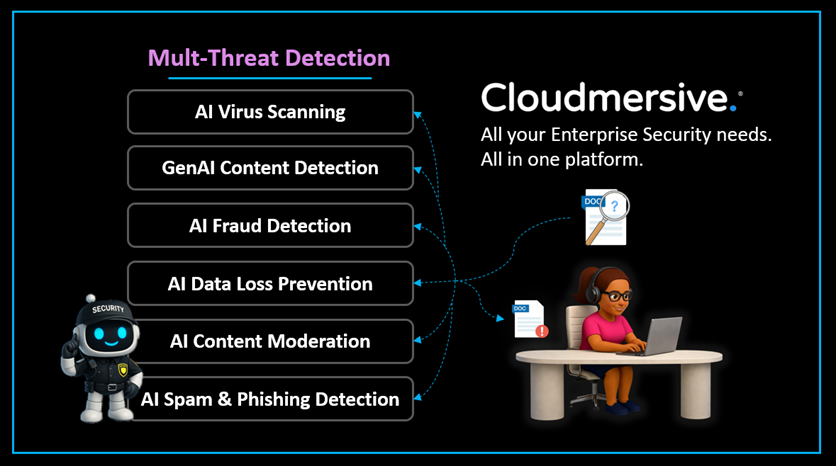
 Virus Scan APIs
 Content Disarm and Reconstruction APIs
 Spam Detection APIs
 Document Conversion & Processing APIs
 Document AI APIs
 Natural Language Processing (NLP) APIs
 Optical Character Recognition (OCR) APIs
 Image and Face Recognition and Processing APIs