
|
| Catch Phishing Threats Instantly with Cloudmersive Multi-Threat Detection |
| 5/27/2026 - Brian O'Neill |
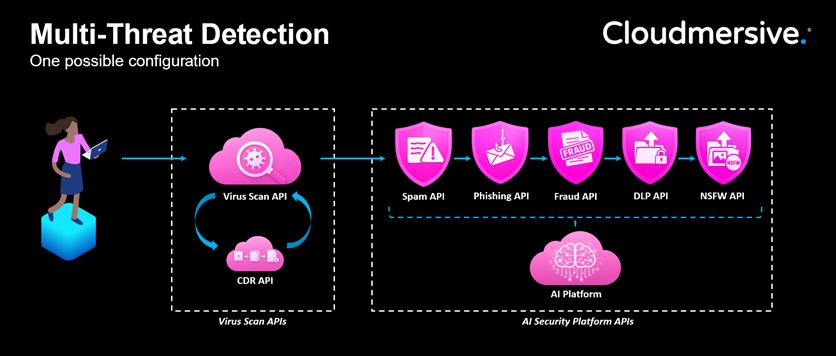
Phishing looks different than it used toJust a few years ago, phishing emails weren't too hard to spot. They were full of poor grammar and generic greetings, and suspicious sender addresses stood out. The phishing URLs were easy enough to identify, and the landing pages were often low-effort and unconvincing. Basic security awareness training was enough to prevent most phishing threats from escalating to credential compromise. Today, that's no longer the case. Generative AI produces grammatically perfect phishing content that's personalized enough to convince even the best-trained users, and on top of that, the average quality of spoofed landing pages has skyrocketed from AI-assisted web development. At this point, it’s not enough to rely on security awareness training to avoid phishing threats. The content detection layer needs to catch up. Why rule-based filtering isn’t enoughTraditional email security tools primarily rely on rules and reputation signals like bad domains, suspicious link patterns, sender reputation scores, and keywords. That approach can work well enough against commodity phishing campaigns, but against targeted, AI-generated phishing content, it misses most of what really matters. AI-generated phishing doesn’t trigger keyword filters because it doesn’t use the language patterns those filters were trained on. On top of that, it doesn’t consistently originate from known bad domains because attackers can rotate infrastructure regularly. Perhaps most importantly, it doesn’t look suspicious to a reputation scoring system because the content itself registers as clean. The threat is in the intent rather than the formatting, and that gives threat actors a big advantage. Catching this type of phishing threat requires understanding what a message is actually trying to do, not just noticing the surface-level message flaws. How the Cloudmersive Phishing Detection API addresses modern phishing attacksThe Cloudmersive Phishing Detection API uses AI deep learning to analyze communications for phishing intent across every channel and content type that matters: emails, text strings, documents, images, and URLs. For email, the phishing API endpoint evaluates the full email message, including everything from embedded URLs to content intent and sender reputation. For text-based communications (e.g., SMS, form submissions, chat messages, etc.), the API accepts prior conversation history as context, which allows the model to factor the relationship between sender and recipient into its assessment rather than evaluating messages in isolation. For documents and files, the API scans embedded URLs stored within the document container, catching phishing attempts that arrive as attachments rather than inline messages. Every phishing API endpoint returns an analysis rationale describing the model’s reasoning for its classification, giving security teams visibility into why a message was flagger (rather than just that it was flagged). Custom policies allow organizations to define what their environment should and shouldn’t tolerate. For example, organizations can decide whether unsolicited sales content or promotional material should be flagged alongside dangerous phishing material for more comprehensive control. Where it fits in your workflowsPhishing threats can enter your organization through any channel that carries communications. While inbound email is of course the highest-volume surface and the most common starting point, you’ll also identify phishing attacks in web forms, API inputs, file uploads, and even direct messages. Any surface where a human or automated system might act on the content of a message is a threat surface. For organizations running Cloudmersive Multi-Threat Detection, phishing detection fits naturally alongside fraud detection in document and communication pipelines. The AI-generation angle connects both endpoints directly; the same capabilities producing fraudulent document alterations are producing more convincing phishing communications than we’ve ever seen before. Running both checks in the same workflow takes care of both vectors in a single pass. Deployment optionsLike all Cloudmersive APIs, the Phishing Detection API is available across the full range of deployment options described below. Enterprises can integrate it wherever it fits best in their existing architecture, and under whatever regulatory or data governance constraints apply to their environment. Managed InstanceThese deployments leverage dedicated, managed infrastructure with SLAs, customizable deployment, and security. Private CloudThese deployments can take place on the customer’s premises or in a cloud platform of their choice. Public CloudThese deployments leverage Cloudmersive’s multi-tenant public cloud offering. PaaSThese deployments take advantage of Azure App Service or Azure Kubernetes Service offerings. Government CloudThese deployments take place in a specified government cloud region, suiting the data governance requirements of government entities. Get started with Cloudmersive AI Phishing DetectionTo learn more about our Phishing Detection API, visit our documentation or API console for technical details and code examples. For expert advice or to book a Multi-Threat Detection demo with your data, reach out to a member of our team. |
Sign Up Now or 

 Blog
Blog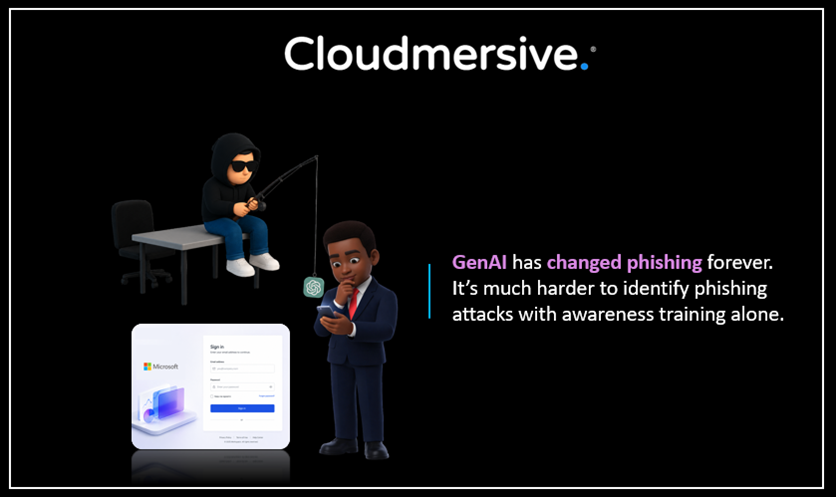
 Virus Scan APIs
 Content Disarm and Reconstruction APIs
 Spam Detection APIs
 Document Conversion & Processing APIs
 Document AI APIs
 Natural Language Processing (NLP) APIs
 Optical Character Recognition (OCR) APIs
 Image and Face Recognition and Processing APIs