
|
| Announcing the Cloudmersive Phishing Detection API |
| 2/25/2026 - Brian O'Neill |
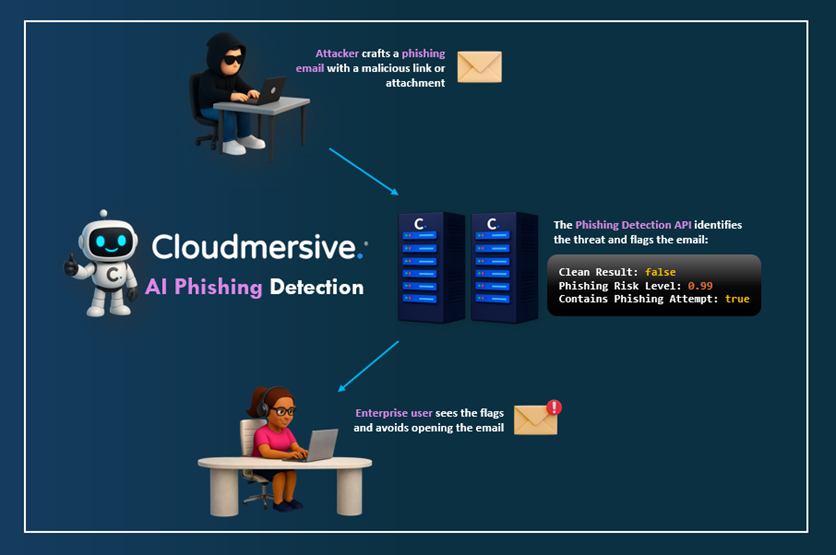
We’re excited to announce the launch of our new Phishing Detection API! This latest addition to our AI-powered security platform detects phishing attacks across text, document, email, and URLs inputs. Why phishing detection matters in modern workflowsDespite spending decades at the forefront of our concerns, phishing remains one of the most persistent and successful attack vectors in enterprise security. Unlike years past, attackers are no longer limited to poorly written emails with obvious red flags. Today’s phishing campaigns leverage AI to generate highly convincing content at scale, and they often embed malicious links inside documents and attachments more effectively than before. On top of this, they now target our inboxes and our internal workflows, exploiting weakly secured file upload portals and collaboration tools. As GenAI tools become more accessible, the scale and sophistication of phishing campaigns continue to increase towards a higher average standard. As a result, organizations need real-time detection at network entry points before phishing content can reach users or downstream systems. What the Phishing Detection API doesCloudmersive AI Phishing Detection identifies phishing (and other unsafe content) across multiple input types. These include text strings (e.g., sales lead inputs), documents (e.g., file uploads in PDF, DOCX, JPG, PNG, etc. format), emails (EML, MSG, and HTML bodies) and URLs (e.g., those with redirects leading to unsafe websites). The underlying AI model analyzes semantic intent and deceptive language patterns in all the above input categories. It fully examines URLs to determine whether they lead to unsafe sites. The result of AI Phishing Detection analysis is a Phishing Detection API methodsThe Phishing Detection API library primarily exposes four phishing detection methods. These correspond to the input types mentioned above.
All the above methods also allow Integration with the broader Cloudmersive platformThe Phishing Detection API works seamlessly in conjunction with other Cloudmersive APIs, including the Virus Scan API, Fraud Detection API, and Document AI API. For example, you could implement Phishing Detection directly after the Virus Scan API checks a document for malware, and directly before the Document AI API classifies or extracts data from that document. The Phishing Detection API is also built into Email Protect, which offers 360-degree AI powered protection for enterprise email inboxes. Flexible deployment modelsAs always, Cloudmersive customers have the option to deploy the Phishing Detection API following several unique deployment models:
Learn MoreWe’re excited to bring AI Phishing Detection to your enterprise! If you’re interested in learning more about Cloudmersive AI Phishing Detection, please visit the [Phishing Detection API](Phishing Detection API - Cloudmersive APIs) home page and reach out to a member of our sales team to set up a demo. |
Sign Up Now or 

 Blog
Blog
 Virus Scan APIs
 Content Disarm and Reconstruction APIs
 Spam Detection APIs
 Document Conversion & Processing APIs
 Document AI APIs
 Natural Language Processing (NLP) APIs
 Optical Character Recognition (OCR) APIs
 Image and Face Recognition and Processing APIs