
|
| What is Quantum Computing |
| 6/4/2026 - Brian O'Neill |
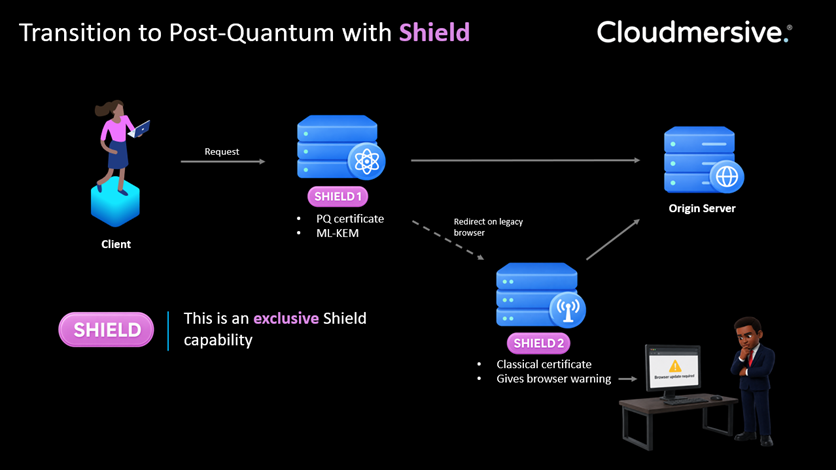
A whole new way of computingEvery computer you’ve ever used works in the same fundamental way. It processes information as bits, which are tiny switches that can live in exactly two states: 1 and 0 (“on” and “off”). Everything a classical computer does, from rendering a video to encrypting a bank transaction, can be boiled down to an enormous sequence of bits occupying one of those two states. Quantum computers break away from that mold entirely. They work on a fundamentally different level. Instead of processing one state at a time, they exploit the behavior of subatomic particles to process many states simultaneously. The result is a new type of machine that is extraordinarily fast – so fast, in fact, that it can solve problems a classical computer would need longer than the age of the universe to solve. To understand why that matters, it helps to understand what’s actually going on inside a quantum computer. The core concepts (without the math)Quantum computing is built on three physics ideas: Superposition, Entanglement, and Interference. They’re a bit strange, but you don’t need a physics degree to grasp the underlying concepts – just a metaphor or two. Superposition is the property that allows a quantum bit (called a qubit) to exist in multiple states at once rather than sticking to 0 or 1. Imagine a classical bit as a coin lying flat on a table after a coin toss: it can be either heads or tails. Now imagine a coin while it’s still spinning in the air before the coin toss: it isn’t heads, it isn’t tails; it’s both, with a probability attached to each outcome. The moment you measure it, it lands, but until then, it carries both possibilities simultaneously. That’s a qubit. Entanglement is what happens when two qubits become linked in such a way that the state of one instantly determines the state of the other, regardless of the distance between them. Think of this like two magic dice on opposite sides of the planet. Every time you roll them they always show the same number, but not because someone coordinated it; because of how they were prepared. If you measure one, you instantly know the other. Quantum computers use entanglement to coordinate qubits in ways that classical systems simply aren’t capable of replicating. Interference is the mechanism that makes quantum computers actually useful rather than just strange. Because qubits carry probabilities, quantum algorithms can be designed to amplify the probability of correct answers and cancel out the probability of wrong ones. Think of how two waves in phase reinforce each other while two waves out of phase cancel out. This is what allows quantum computers to arrive at the right answer efficiently rather than just generating a cloud of random results. Together, these three properties allow a quantum computer to explore an overwhelming number of possible solutions to any given problem at the same time, rather than working through each solution one by one. What fully-fledged quantum computers will actually be good atQuantum computers are frequently misunderstood as a newer, faster generation of classical computers. It’s important to quash that idea right now: they aren’t. A quantum computer won’t load a webpage faster than your current machine, or run a spreadsheet more efficiently. And it won’t make your video calls any clearer. For most everyday computing tasks, a classical computer will still be the right tool to use. Where fully-fledged quantum computers will excel is a certain class of mathematical problems. Specifically, ones that involve searching through enormous solution spaces or factoring very large numbers (something classical computers are terrible at). Fields like drug discovery, climate modeling, logistics optimization, and materials science will all benefit enormously from this capability. One great example of this is a classically frustrating computer science problem called the “traveling salesman” problem. This problem deals with the challenge of finding the most efficient route through a large number of destinations, and it scales into near-impossible time complexity for classical computers – but it’ll be a practical problem for quantum computers to solve at scale, unlocking real efficiency gains in logistics and supply chain management. Unfortunately, however, quantum problem-solving capabilities apply equally to a problem most people never have to think about: the mathematical foundations that make modern internet encryption work. At a basic level, modern encryption relies on mathematical problems that are easy to perform in one direction and practically impossible to reverse without a key. What we’re specifically referring to here is RSA encryption, the cryptographic system protecting most secure internet traffic today. It works by exploiting a simple asymmetrical property in mathematics: multiplying two large prime numbers together is trivial, but factoring the result back into its original primes is computationally infeasible for a classical computer (when the numbers are large enough). A classical computer attempting to factor a 2048-bit RSA key would literally take longer than the age of the universe to get to the answer, and that’s enough time to keep your credit card data (along with myriad other examples) safe. A sufficiently powerful quantum computer running an algorithm called Shor’s algorithm, which is the method used to solve the factoring problem on paper, will be able to factor those large numbers efficiently. The asymmetry RSA relies on will disappear entirely. Where quantum computing is todayCurrent quantum computers are very real and advancing rapidly. However, they aren’t yet capable of breaking modern encryption because they’re limited by qubit count and error rates. Quantum systems are extraordinarily sensitive to environmental interference, too, and managing errors at scale remains one of the central engineering challenges in the quantum computing field. Most credible estimates place a cryptographically relevant quantum computer (one capable of breaking RSA or ECC encryption at the key sizes currently in use) somewhere between 5-15 years away. However, that range is narrowing as investment accelerates; excitement is growing, and there’s regular news reporting on this subject. Governments, major technology companies, and defense organizations around the world are treating this as an engineering problem that’s being actively solved rather than a theoretical curiosity. It’s important to note that nobody knows exactly when a cryptographically relevant quantum computer will exist. What is known is that the timeline is, in fact, finite, and that it is shortening. Most importantly, it’s very well known in the engineering community that the infrastructure changes required to respond to quantum computing take years to implement at scale. Overhauling cryptographic standards is an immense task, and it’s crucial to start sooner rather than later. Why cryptographers are already worriedNobody is worried about quantum computers breaking encryption today, because they can’t do that. The real concern amongst cryptographers and security professionals is what happens in the years between now and when they can, and what’s already happening in anticipation of that. There’s a real fear that threat actors may be intercepting and storing encrypted data in anticipation of a quantum breakthrough. If that data contains anything that will still be sensitive 5, 10, or 15 years into the future, the bet is worth making. Things like government secrets, medical records, financial data, and intellectual property need to be secure forever, and they may not be sooner than you think. Migration time to post-quantum infrastructure is the second part of this problem. New standards need to be developed, tested, proven, adopted, and deployed across every single system that relies on encryption across the entire world. That process is underway already, but it takes years, and the clock is ticking. Learn moreTo learn more about the steps you need to reach post-quantum readiness, contact a Cloudmersive expert now. Shield, Cloudmersive’s multi-threat detection reverse proxy solution, is equipped to handle all post-quantum rollouts and forge a short, managed timeline to post-quantum readiness. |
Sign Up Now or 

 Technical Articles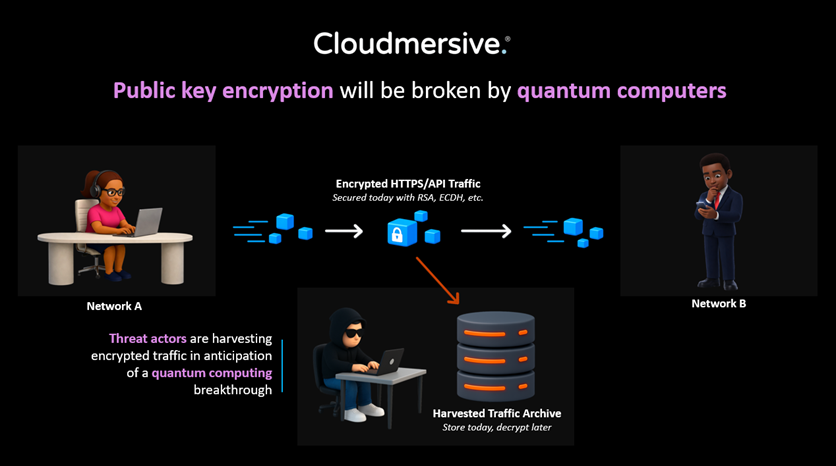
 Virus Scan APIs
 Content Disarm and Reconstruction APIs
 Spam Detection APIs
 Document Conversion & Processing APIs
 Document AI APIs
 Natural Language Processing (NLP) APIs
 Optical Character Recognition (OCR) APIs
 Image and Face Recognition and Processing APIs