
|
| What is Post Quantum Cryptography |
| 7/6/2026 - Brian O'Neill |
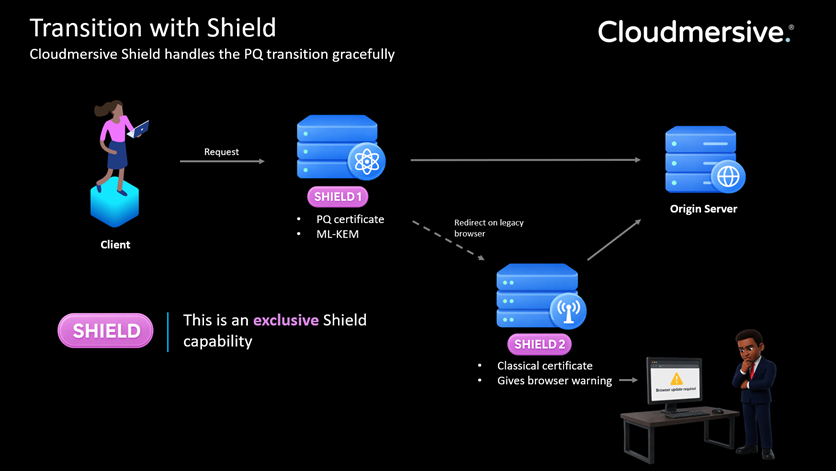
A new way to protect dataCryptography isn’t the type of thing most people spend a lot of time thinking about. Encryption is just supposed to work, and currently, that’s exactly what it does. With quantum computing looming on the horizon, however, the long-term security guarantees of traditional public-key encryption are starting to look time-limited. Understanding the encryption we have nowWhen you open a secure website, submit a payment, upload a private document, connect to a VPN, or even sign into an application, encryption is quietly doing its job in the background. It protects the information moving between systems, verifies identities, and helps keep attackers from reading or modifying sensitive data. For decades, that model has worked perfectly because public-key cryptography relies on math problems that are easy to perform in one direction and extremely difficult to reverse. RSA encryption, for example, depends on the difficulty of factoring a very large number back into the two prime numbers that created it. Elliptic curve cryptography, or ECC, depends on a different problem involving points on a curve, where moving forward is efficient but working backward (without a private key) is computationally unrealistic. In short, both public-key cryptographic approaches strategically exploit the limitations of modern computers by making decryption infeasible for a third party. How quantum computing breaks modern encryptionA sufficiently powerful quantum computer won’t play by the same rules as modern computers. It’ll create an entirely new class of security problem by breaking some of the mathematical foundations modern encryption depends on. Factoring large numbers into their prime factors and moving backwards on an elliptic curve won’t take nearly as long. While that doesn’t mean every encrypted system will fail overnight, or even that quantum computers can break encryption today, it does mean the security world has to prepare for a very different future once cryptographically relevant quantum computers exist. Post-quantum cryptography is concerned with preparing for this eventuality. What post-quantum cryptography actually meansPost-quantum cryptography (PQC) is a new generation of cryptographic algorithms designed to remain secure against attacks from future quantum computers. It’s important to note that this doesn’t imply PQC requires a quantum computer to run, nor does it require quantum hardware. And it’s not the same thing as quantum key distribution, which uses physics to exchange keys. The important thing about post-quantum cryptography is that it runs on classical computers, servers, browsers, applications, and devices. The goal is to replace quantum-vulnerable public-key algorithms with new ones based on math problems that both classical and quantum computers are believed to struggle with. It’s about surviving quantum attacks on our data. The new standardsThe National Institute of Standards and Technology (NIST) has now finalized its first post-quantum cryptography standards. These give governments, enterprises, vendors, and infrastructure providers a solid foundation for migrating away from quantum-vulnerable cryptographic techniques. Like many of the powerful algorithms we take for granted today, post-quantum cryptographic algorithms first lived as hypothetical solutions in research papers and standards discussions for years before reaching the point of serious, practical implementation. The three major standards for PQC are:
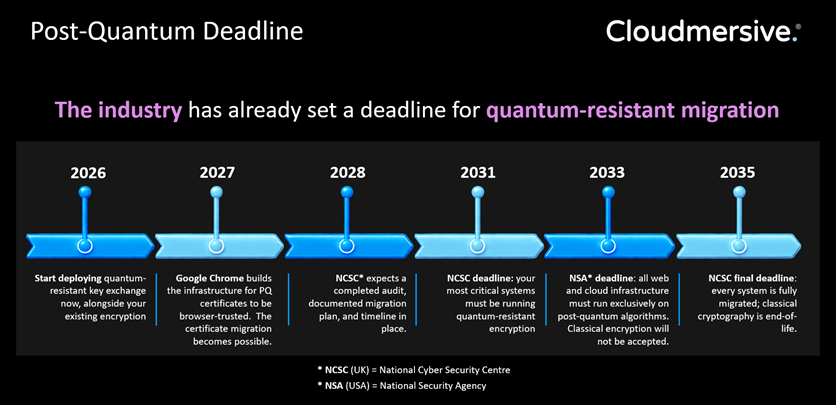
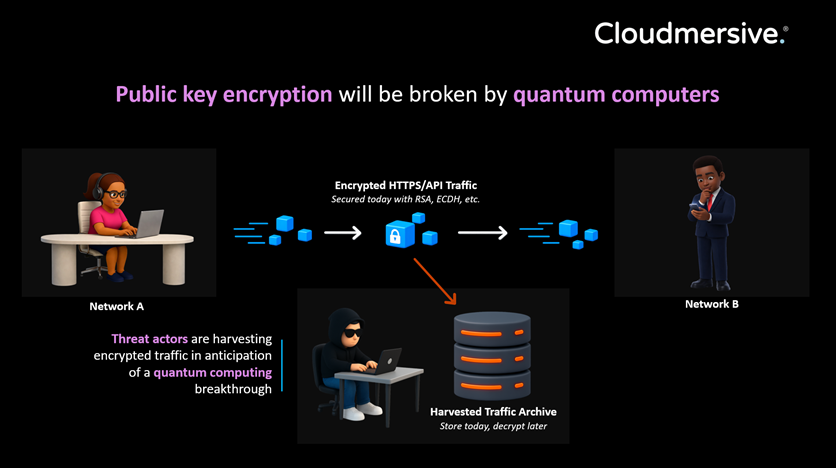
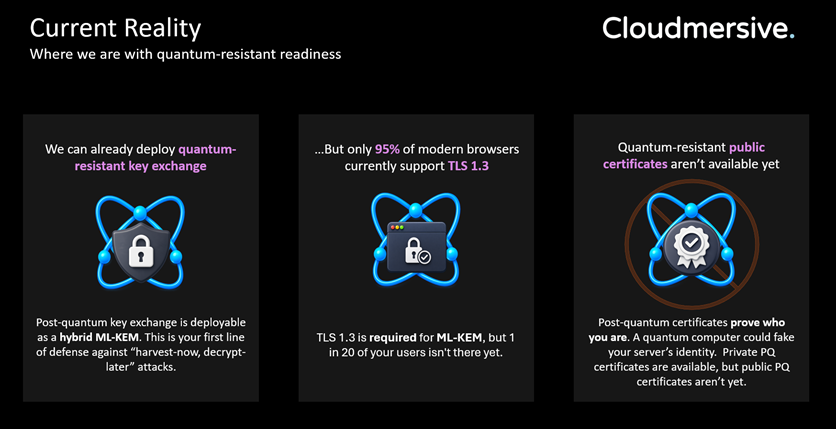
There’s no need to memorize these names to understand the point; the important thing is that post-quantum cryptography has moved from theory to standardization, and the migration path is starting to take shape. Organizations can no longer treat quantum-safe security as some distant academic issue for future decision makers to untangle. The difficult thing, however, is adoption. Replacing current encryption standards with PQC standards is a massive undertaking. Why “harvest now, decrypt later” changes the PQC timelineIt’s easy to read about quantum risk and assume the problem starts when quantum computers can break encryption. Unfortunately, that’s not the case. The fact is there’s nothing stopping attackers from collecting encrypted data today and holding onto it until they have the ability (e.g., with a sufficiently powerful quantum computer) to decrypt it later. This is called a harvest now, decrypt later attack, and it sounds speculative until you think about the kinds of data that stay sensitive for years. Medical records, for example, don’t just stop being private after a few months, and government documents can similarly remain sensitive for decades. The list goes on: financial records, legal files, intellectual property, product designs, customer identity documents, research data, and national security information can all retain long-term value for attackers. If an attacker believes a quantum computer might be able to decrypt your data in 5, 10, or 15 years, storing it now is more of a rational bet than a speculative one. That’s why it’s the wrong strategy to wait for a cryptographically relevant quantum computer to exist: by the time one exists, the damage may already be sitting in someone else’s archive. Where quantum risk hidesMigrating to PQC is difficult because cryptography is everywhere. It’s embedded across the entire digital environment, not just one product or server, and while some of it is visible, a lot of it isn’t. You may have quantum-vulnerable cryptography sitting in web servers, TLS configurations, VPNs, API gateways, identity providers, cloud services, databases, backups, mobile applications, embedded devices, payment systems, file transfer tools, email systems, and third-party integrations. That’s a mouthful, but there’s no running from the scope of this risk – it needs to be embraced fully. That’s why this transition is so different from a normal security upgrade. Whereas vulnerable endpoints can be patched and weak password policies can be changed, cryptographic migrations must move through the entire connective tissue of an organization. Why this is really an infrastructure problemIt’s understandable if, after reading down to this point in the article, you’ve begun to think about post-quantum readiness as a cryptography problem. Technically, that’s true. But operationally, it’s much bigger than that. The reality is that most organizations don’t have a clean map of every place cryptography is used. They don’t always know which systems use RSA, which use ECC, which libraries handle key exchange, which certificates depend on which algorithms, and which vendors are ready for post-quantum standards. They don’t know which integrations will break if changes are made too quickly (and the answer is probably a lot of them). Obviously, that creates a major migration problem. Changing cryptography without breaking production systems requires an exhaustive, methodical approach. There needs to be discovery, staging, routing, compatibility planning, monitoring, rollback options, and a realistic understanding of which systems matter most to the organization. There’s a nice buzzword-y term for this: crypto-agility. This refers to the ability to change cryptographic algorithms, protocols, and configurations without rewriting or rebuilding everything around them. In a post-quantum world, crypto-agility is not a nice-to-have feature; it’s the thing that determines whether an organization can adapt on a managed timeline or scramble under pressure. In short, the organizations that prepare early will have time to inventory systems, test hybrid approaches, coordinate vendors, and roll out changes carefully, while the organizations that wait will have to do the same work later, with less time to act and far more risk on their plate. What post-quantum readiness looks likeTo be a post-quantum-ready organization, you don’t necessarily need to replace everything all at once. Instead, you just need to know where the cryptography lives in your organization, and understand which systems protect long-lived sensitive data. Once you’ve structured your priorities correctly, you need a plan for replacing quantum-vulnerable algorithms, and a plan to test and deploy new cryptographic standards without breaking critical services. With those pieces in place, you can work with vendors from a position of knowledge rather than guesswork, and you can continue to adapt as standards, protocols, browsers, operating systems, and enterprise platforms continue to evolve. This last piece matters a great deal. Post-quantum security will be an ongoing transition, not just a one-time event. Algorithms will mature, libraries will change, and vendors will roll out support at different speeds. As more knowledge is accumulated, compliance expectations will evolve, and infrastructure teams will need to update systems in phases. When all is said and done, the safest organizations will be the ones that treat post-quantum readiness as an infrastructure capability instead of a last-minute compliance project. Preparing for the post-quantum futureWe’re not in danger of having our modern encryption algorithms broken today. But the timeline for post-quantum migration has already begun, and you don’t want to get left behind. There’s a real risk that organizations underestimate both how long the PQC transition will take and how deeply modern cryptography is embedded in their infrastructure. Perhaps most worryingly, there’s a huge risk that organizations underestimate the damage of harvest now, decrypt later attacks in the future. PQC gives organizations a path forward, but knowledge and acceptance of standards do not create readiness on their own. Readiness comes from thorough inventory, planning, testing, controlled deployment, and the ability to change cryptography without disrupting the systems that depend on it. That work should start now, not tomorrow. Learn moreTo learn more about reaching post-quantum readiness in your organization, contact a Cloudmersive expert now. Shield, Cloudmersive’s multi-threat detection reverse proxy solution, is equipped to support post-quantum rollout planning and help organizations move toward quantum-safe infrastructure on a shorter, more controlled timeline. |
Sign Up Now or 

 Technical Articles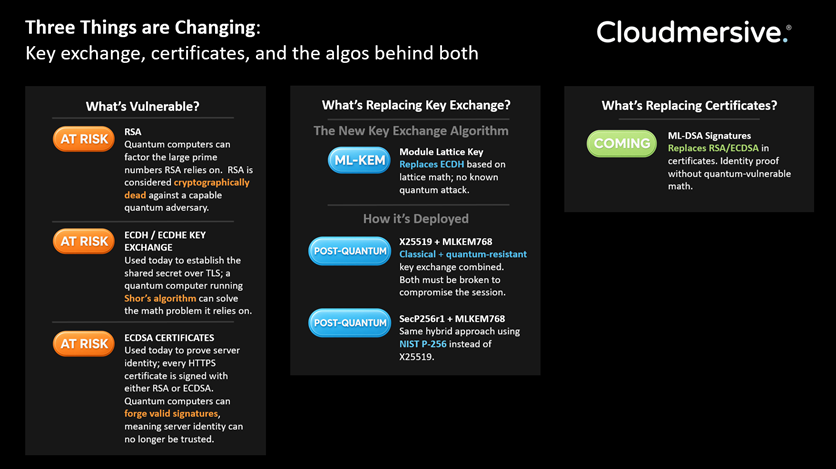
 Virus Scan APIs
 Content Disarm and Reconstruction APIs
 Spam Detection APIs
 Document Conversion & Processing APIs
 Document AI APIs
 Natural Language Processing (NLP) APIs
 Optical Character Recognition (OCR) APIs
 Image and Face Recognition and Processing APIs