
|
| How to Protect Azure API Management from Malicious File Uploads |
| 5/5/2026 - Brian O'Neill |
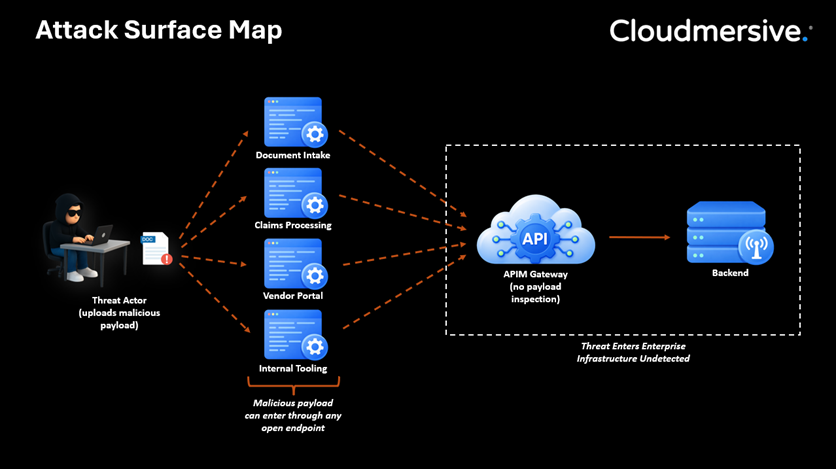
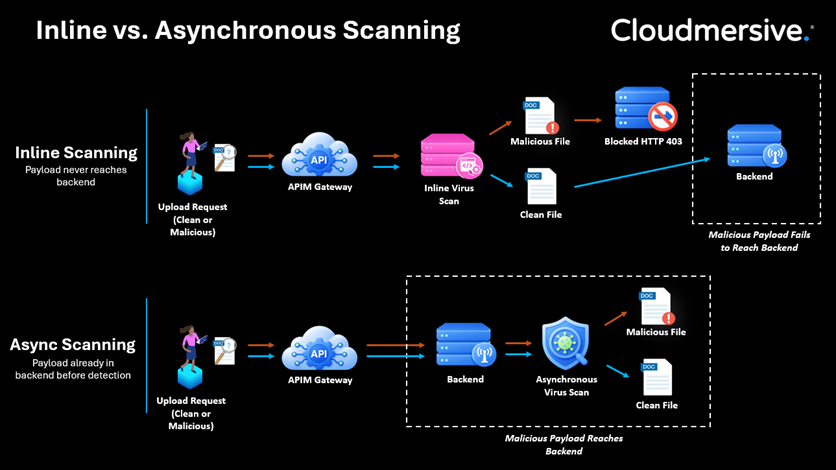
The APIM ProblemAll enterprise infrastructures are full of vulnerable surfaces. Among those, APIs that accept file uploads are one of the most easily exploitable areas. Any endpoint accepting binary payloads instantly becomes a potential delivery mechanism for malware and zero-day threats. Unlike most web application vulnerabilities (e.g., SQL injection or cross-site scripting), file upload attacks don’t require sophisticated exploitation techniques to reach sensitive backend systems. They only need two things: an open endpoint and a malicious file. For enterprises running on Azure, the most pressing issue is that Azure API Management (Azure APIM) doesn’t have built-in policies for inspecting binary payloads. Without that additional layer, file upload requests head straight to backend systems without any malware screening applied along the pipeline. That’s a significant gap, and it tends to go unnoticed longer than it should. Security teams typically expect controls to be in place at every layer of the request pipeline, including the gateway, but development teams building on Azure APIM often miss the fact that file upload inspection requires external integration (that is, until something forces the conversation to happen). By the time that does get noticed, the gateway has usually been sitting open for a while, and that means any number of malicious files could’ve passed through unchecked. For technology decision makers, the question isn’t about whether this type of gap exists or not (it does in most cases). The question is how to close that gap without disrupting the architecture they already have in place. Why File Upload Scanning Belongs in Your API GatewayClosing that gap is a decision with direct consequences for the business. It’s not something that can be avoided for long. The fallout from a successful file upload attack is serious enough that it calls for real architectural attention. If a single malicious file reaches a backend system, it can move quickly throughout internal networks and compromise downstream integrations like databases and message queues. It can even trigger severe data breach scenarios. Recovery costs and regulatory penalties incurred from these breaches aren’t cheap, and they tend to make the cost of preventative controls look trivial in hindsight. It’s worth noting that compliance pressure is also moving in this direction. Standards like SOC 2 and ISO 27001, for example, along with frameworks tied to HIPAA and PCI-DSS, increasingly expect security controls to be deployed at API ingress points rather than just sitting at the network perimeter. When auditors review system architecture, they want evidence that files are inspected at the point of entry. Unscreened file upload endpoints are likely to show up in audit reports and turn into remediation timelines. Nobody wants to manage that after the fact. The attack surface is also much wider than most development/security teams typically account for. A much broader range of enterprise workflows possess file upload endpoints than teams might initially expect, from document intake and claims processing workflows to vendor portals and internal tooling. Each individual endpoint represents a potential entry point for malicious files, and the variety of accepted payload formats between those endpoints means a single policy gap can expose multiple vectors at once. Considering reactive detection tools can only catch threats after a payload has traversed the network, it’s clear those types of policies aren’t a viable strategy at enterprise API request volumes. What a Real Solution Looks LikeThere's good news on this front: closing the gap doesn’t necessitate rearchitecting anything. Thankfully, it only requires adding the right scanning layer in the right place (and understanding what that actually means in practice). The most important requirement is inline scanning. Asynchronous approaches inspecting payloads after request forwarding would miss the point entirely. A viable scanning solution must:
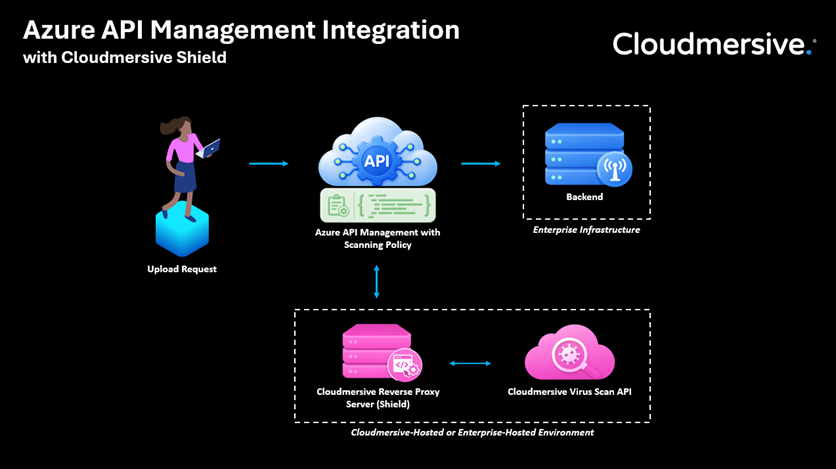
Anything else would constitute logging threats rather than preventing them. It’s also important that a solution to this problem doesn’t create a new one by adding a second proxy into the request path. This is a common architectural concern, and it’s a legitimate one. A two-proxy solution (i.e., a scanning proxy layer in front of Azure APIM) adds latency and increases complexity, and it creates a new point of failure in the pipeline. The right approach is to integrate scanning as a policy-driven step; this is exactly what was missing from the out-of-the-box solution in the first place. This keeps the APIM as the sole traffic proxy. Once policies are implemented, coverage also needs to match the full scope of the payload landscape. While it would certainly be convenient if all APIs dealt with a single upload format, that’s rarely the case, and a solution which only inspects one format leaves others exposed. Exclusively inspecting multipart form data, for example, leaves JSON binary and raw POST endpoints exposed. Consistent, comprehensive scanning across all accepted payload formats is a baseline solution requirement. Finally, the breadth of any threat detection policy must be carefully considered. If signature-based scanning is relied upon (i.e., using a signature database to identify known malware threats, as many antivirus solutions do), the problem isn’t really solved. Zero-day exploits and novel malware variants don’t appear in antivirus databases until after they’ve already caused damage somewhere, and no signature-scanning enterprise is above becoming the horror story everyone else learns from. For inline scanning to be effective, it must account for threats that haven’t been catalogued and studied yet, and that means detection capability itself matters just as much as where the scanning happens in the pipeline. How Cloudmersive Shield and a Single APIM Policy Close the GapThe integration Cloudmersive offers for Azure APIM checks every one of those boxes, and implementation is straightforward enough that it doesn’t require a significant engineering investment. The mechanism: a single XML policy added to the inbound processing configuration of the target API in Azure APIM. Before inbound requests proceed further, they’re routed to Cloudmersive Shield for scanning. That means:
One single policy addition is all it takes to enable scanning across any API in an existing APIM deployment. This model doesn’t introduce a second proxy in the request path, either. Azure APIM remains the sole proxy handling incoming traffic. Cloudmersive Shield operates in “scanning-only” mode, sitting outside the proxy chain entirely and returning a scanning verdict rather than forwarding traffic. When files are determined to be clean, they continue through Azure APIM to the backend with no modifications. When files are determined to be malicious, they trigger an automatic HTTP 403, and Azure APIM returns that directly to the client before the request ever reaches the backend. Shield covers all three payload formats enterprises are likely to encounter:
Security policies for each format can be configured independently in the Cloudmersive Management Portal. That means teams with APIs accepting multiple upload formats can easily enforce consistent scanning across all of them from a single configuration, rather than managing separate solutions for every endpoint. Concerning threat detection metrics: Cloudmersive Advanced Virus Scanning performs exceptionally well. The Cloudmersive Virus Scan API maintains a Zero-Day Detection Rate (ZDDR) of 98% against threat samples not yet stored in antivirus signature databases, and it layers signature-based scanning on top of that for comprehensive threat protection. Novel threats and known malware signatures are caught at the point of entry, not surfaced after the fact by downstream security tools. The Virus Scan API also supports threat rules which can be tuned to block specific threat types like executables, scripts, macros, password-protected files, and more. Security teams can configure these rules to their liking for more precise control over what content is and isn’t permitted through their upload endpoints. For deployment, Shield can be stood up as a Cloudmersive Managed Instance or deployed via Private Cloud. The latter includes Azure-native options such as:
Enterprises with stringent data residency or infrastructure governance requirements can also run Shield entirely within their own environment without routing payloads through Cloudmersive infrastructure. ConclusionFile upload endpoints are vulnerable and frequently underestimated, and Azure APIM’s lack of built-in content inspection policies means that gap is easy to miss. Cloudmersive Shield addresses this gap directly and smoothly, slotting into an existing APIM deployment through a single policy addition. It delivers inline advanced scanning without the additional overhead of deploying a separate proxy, and it doesn’t require any changes to backend systems. For enterprises that need to seal up APIM gaps quickly and cleanly, Shield is a straightforward and powerful coverage layer. For expert advice on deploying Cloudmersive Shield in your environment, please reach out to our team directly. |
Sign Up Now or 

 Technical Articles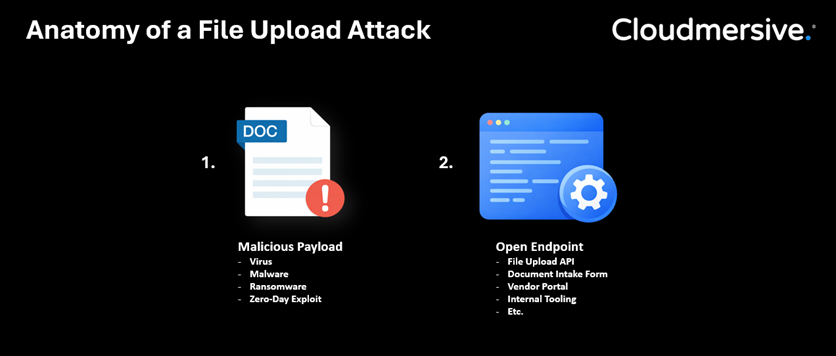
 Virus Scan APIs
 Content Disarm and Reconstruction APIs
 Spam Detection APIs
 Document Conversion & Processing APIs
 Document AI APIs
 Natural Language Processing (NLP) APIs
 Optical Character Recognition (OCR) APIs
 Image and Face Recognition and Processing APIs