
|
| How to Detect Fake AI Generated Documents |
| 5/12/2026 - Brian O'Neill |
AI-generated document fraud is one of the fastest growing threats in enterprise security. The same generative AI tools that have made content creation faster and more accessible to everyone have also reduced the effort it takes to fabricate convincing documents. Insurance companies now deal with significantly more instances of fake insurance claims, and accounting teams in every vertical now see drastically more forged invoices in their pipelines. Perhaps most troubling is what isn’t seen. Unlike older forgery methods, AI-generated documents are often indistinguishable from legitimate ones at a glance, and that means the problem may be even larger and more widespread than companies realize. Traditional fraud detection approaches built on pattern matching and rule-based checks were designed for a different version of this threat landscape, and many of them are effectively blind to what’s really coming through enterprise pipelines today. What Makes AI-Generated Documents Hard to Detect?Aren’t AI-generated documents just low-quality fakes?Early AI models gained a reputation for generating low quality easy-to-spot “slop”, but that’s not always the case anymore. Those early instances of AI fraud tended to contain obvious artifacts like unusual phrasing and inconsistent formatting, or even visual distortions in image-based documents. Modern versions of these models have grown past their early ancestors, producing output that is both semantically coherent (often with more grammatical nuance) and visually polished. A fraudulent invoice generated by a capable AI model can now appear structurally identical to a legitimate one from a known, trusted vendor. Don’t existing fraud detection tools cover this?Traditional fraud detection tools were designed to catch known patterns from real-world fraud examples. They typically look for mismatched fonts and altered metadata, or document structures that deviate from expected templates. Today’s AI-generated documents don’t necessarily trigger any of those signals because they’re built from scratch rather than modified from some legitimate source. Without an original document to compare against, there’s no clear alteration to detect. Why is this an enterprise-level problem specifically?In the past few years, you’ve probably received an increasing number of text messages and emails on your personal device which contain AI-generated images of fake court summons or other fear-inducing content. Those examples are low quality and low effort, reflecting a lower expectation of financial reward. The payout for defrauding you is worth far less effort than the payout for defrauding your enterprise, and that’s exactly the tantalizing prospect driving higher instances of quality fraud into enterprise document pipelines. Enterprises that accept documents as part of business processes, insurance carriers reviewing claims, financial institutions processing loan applications, procurement teams handling vendor invoices: all are directly exposed. A convincing AI-generated document submitted through a legitimate intake channel can result in fraudulent payments, incorrect policy decisions, compliance violations, and other disastrous outcomes before anyone realizes something is wrong. The volume of documents flowing through enterprise workflows makes the manual review you perform on your personal device impractical at scale. Key Detection Signals for AI-Generated DocumentsIn today’s fraud landscape, an effective AI document fraud detection tool must look for a combination of signals rather than relying on any single fraud indicator. Some of the most meaningful signals are outlined below.
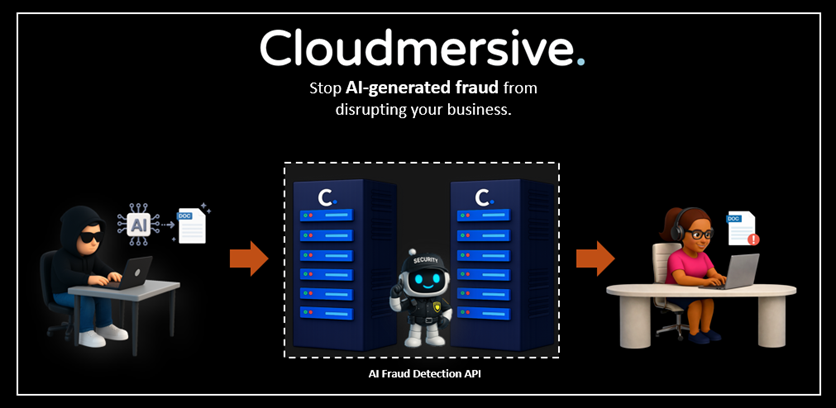
It’s important to note that no single flag is definitive on its own. A reliable fraud assessment comes from interpreting a combination of signals. How the Cloudmersive AI Fraud Detection API Approaches This ProblemThe Cloudmersive AI Fraud Detection API evaluates documents against all high-probability signals in a single API call, returning a structured result which covers each independent fraud signal category alongside an overall risk score and a plain-language rationale (explaining how the assessment was reached). ContainsAiGeneratedContent
This flag is particularly relevant to the current fraud landscape. The volume of AI-generated fraudulent documents is increasing as AI generation tools become more accessible and capable. Flagging The Full Fraud Detection ResponseThe full API response surfaces the complete set of fraud signals in a single structured object.
User Context ScoringLayered context analysis is part of what makes Cloudmersive AI Fraud Detection a flexible, modern tool. The API accepts optional user context parameters alongside the document itself; passing a submitter’s email address and verification status allows the fraud risk assessment to factor in submission-level signals rather than simply evaluating the document in isolation. Deploying AI Document Fraud Detection in an Enterprise WorkflowThe Cloudmersive AI Fraud Detection API works with a wide range of common input formats, including:
This covers the document types most likely to enter real enterprise file upload endpoints, and it largely eliminates the need to convert formats before scanning. The most natural point for deployment is the file intake step, immediately after a document is received and before it can be acted on by a downstream system or system user. A document flagged with a high Enterprises with unique risk thresholds can use the Key TakeawaysIn this article, we’ve learned that:
For expert advice on integrating Cloudmersive AI Document Fraud Detection into your enterprise workflow, please do not hesitate to contact the Cloudmersive team directly. |
Sign Up Now or 

 Technical Articles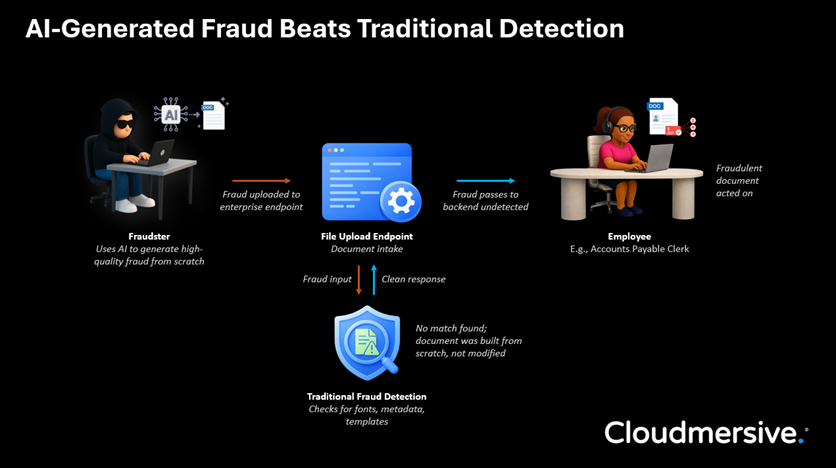
 Virus Scan APIs
 Content Disarm and Reconstruction APIs
 Spam Detection APIs
 Document Conversion & Processing APIs
 Document AI APIs
 Natural Language Processing (NLP) APIs
 Optical Character Recognition (OCR) APIs
 Image and Face Recognition and Processing APIs